
Diagnosing a 1 GB ViewTreeObserver Memory Leak with Perfetto

Motivation
How does a single background scrim view (a semi-transparent overlay that dims background content to focus attention on a modal or drawer) end up retaining nearly a gigabyte of memory in a production application? Memory leaks in Android are common, but few are as destructive as those involving ViewTreeObserver.
In this article, we will walk through a common but often misunderstood pattern: memory leaks caused by ViewTreeObserver listeners. We will look at how these leaks manifest, use Perfetto to identify them, and see how to implement safe engineering patterns to fix them.
The Lifetime Mismatch: Who Actually Owns ViewTreeObserver?
Before diving into heap dumps or traps, it's crucial to understand a fundamental architectural detail in Android:
A ViewTreeObserver isn't owned by the individual View. Once attached, all views in the same ViewRoot share the hierarchy's ViewTreeObserver. Therefore, registering a listener from a short-lived object (such as a Fragment) effectively stores that callback in a potentially much longer-lived ViewRoot. If the listener captures the Fragment and isn't unregistered during teardown, the ViewRoot will retain the destroyed Fragment for as long as that window hierarchy remains alive.
 Figure 1: Retention path showing how ViewTreeObserver at the ViewRootImpl window root retains a destroyed Fragment and its view hierarchy.
Gathering Data: The Warning Signs
Every investigation starts with a symptom or an alert. In our case, automated telemetry pipelines flagged creeping memory issues in large-scale applications.
Real World Impact Stats:
- A single leaking observer retained ~900 MB of memory across 58 dead view trees and native graphics buffers.
- Orphaned observers retained 61.1 MB per trace, stranding custom audio player UI components.
- Leaks retained up to 12.8 MB per trace, holding high-resolution image thumbnails in memory.
Forensic Investigation: Heap Dumps in Perfetto
Knowing that observers can hold dead UI hierarchies is one thing; pinpointing the exact line of code holding the reference in a production trace is another.
When telemetry alerts flag high memory retention, diagnosing the root cause requires inspecting the app's Java Heap Graph.
Try it on your app: If you haven't analyzed a heap dump in Perfetto yet, try capturing one after going through a complex flow in your app. It’s one of the fastest ways to uncover hidden retention chains. Check out the official Perfetto Guide to get started.
Step 1: Spotting the Anomaly in the Heap Profile Flamegraph
Navigating to the Heapdump Explorer in the left sidebar and opening the Flamegraph tab (set to Top Down view) immediately revealed the smoking gun.
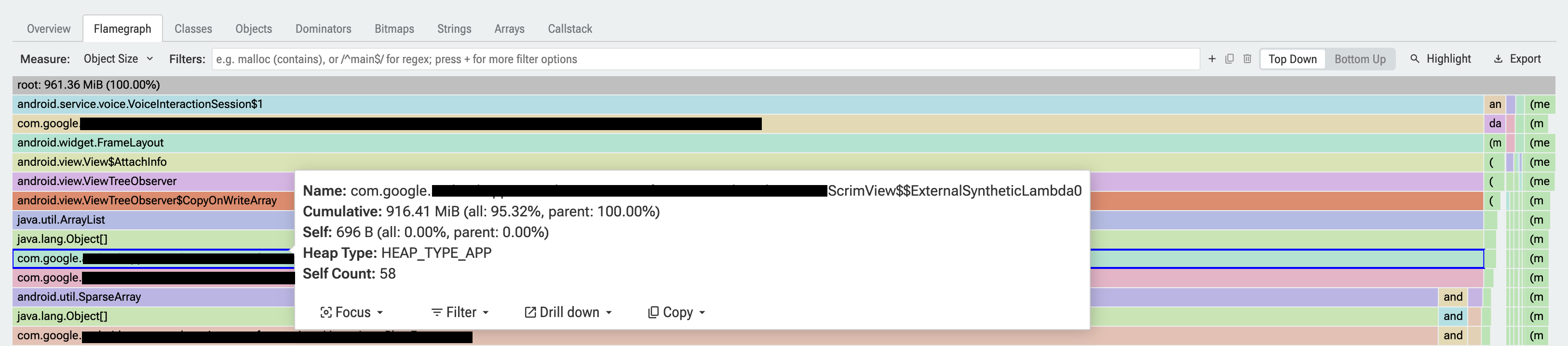 Figure 2: Perfetto Heap Profile Flamegraph (Top Down view) showing ViewTreeObserver leading into ScrimView$$ExternalSyntheticLambda0 taking up ~95% of the heap.
Instead of memory being distributed across various features, nearly 100% of the ~1 GB retained footprint formed a solid, uninterrupted column flowing straight down through the window hierarchy: View$AttachInfo ➡️ ViewTreeObserver ➡️ ViewTreeObserver$CopyOnWriteArray ➡️ … ➡️ ScrimView$$ExternalSyntheticLambda0 [58 instances] ➡️ ScrimView [58 instances]. When a single leak site accumulates dozens of dead View hierarchies spanning the entire width of your application's flamegraph, you know you've found the culprit.
Step 2: The Root Cause in Code
To understand why ScrimView$$ExternalSyntheticLambda0 was registered and never removed, we inspect ScrimView.kt:
// ⚠️ Problematic Code in ScrimView.kt
fun updateListener() {
    if (isAttachedToWindow && overrideOpacity == null) {
        if (!isRecomputeScrimListenerAttached) {
            viewTreeObserver.addOnPreDrawListener(recomputeScrimListener)
            isRecomputeScrimListenerAttached = true
        }
    } else {
        viewTreeObserver.removeOnPreDrawListener(recomputeScrimListener)
        isRecomputeScrimListenerAttached = false
    }
}

override fun onAttachedToWindow() {
    super.onAttachedToWindow()
    updateListener()
}

override fun onDetachedFromWindow() {
    super.onDetachedFromWindow()
    updateListener() // 🚨 THE BUG!
}
Bug explanation
Developers often assume isAttachedToWindow returns false inside onDetachedFromWindow(). However, AOSP's View.dispatchDetachedFromWindow() invokes onDetachedFromWindow() before setting mAttachInfo = null.
dispatchDetachedFromWindow()
  ├── 1. onDetachedFromWindow()           <-- isAttachedToWindow is STILL TRUE!
  ├── 2. onViewDetachedFromWindow()       <-- isAttachedToWindow is STILL TRUE!
  └── 3. mAttachInfo = null;              <-- Flag reset happens HERE at the end
When ScrimView.onDetachedFromWindow() executed:
isAttachedToWindowreturnedtrue.- Because
overrideOpacitywasnull,if (isAttachedToWindow && overrideOpacity == null)evaluated totrue. updateListener()entered the registration block instead of the teardownelseblock.- Because
isRecomputeScrimListenerAttachedwas alreadytrue, execution silently did nothing.
The listener was never unregistered and remained attached to the window's ViewTreeObserver indefinitely.
Step 3: Uncovering the Retention Path (The Chain of Blame)
How does this listener leak end up holding nearly a gigabyte of memory?
By tracing the reference path downward from the flamegraph, we can see the cascade of references.
- Listener Attachment: When
ScrimViewis attached to a window,onAttachedToWindow()callsupdateListener(), registeringrecomputeScrimListener(ScrimView$$ExternalSyntheticLambda0) onViewTreeObserver. - Implicit Reference: In Kotlin, lambdas and method references (like
this::recomputeScrim) implicitly capture an outer 'this' reference. The compiler generates a synthetic class (ScrimView$$ExternalSyntheticLambda0) that holds a strong reference to theScrimViewinstance, making the registered callback a persistent anchor for the entire view. - Detachment Lifecycle Flaw: When
ScrimViewis being detached,dispatchDetachedFromWindow()invokesonDetachedFromWindow(). BecausemAttachInforemains non-null during execution ofonDetachedFromWindow(),isAttachedToWindowreturnstrue. - Bypassed Unregistration: In
updateListener(),if (isAttachedToWindow && overrideOpacity == null)evaluates totrue. Thus, execution enters theifblock instead of theelseblock containingviewTreeObserver.removeOnPreDrawListener(recomputeScrimListener). - Memory Accumulation: With each open/dismiss cycle of the transient UI overlay,
ViewTreeObserver.mOnPreDrawListenersretained another deadrecomputeScrimListener. BecauseScrimView.mParentchains all the way up through the view hierarchy toFragmentManager, leakingScrimViewretained the entire destroyedFragmentinstance, itsViewModelreferences, and all associated child views. Over 58 user interactions, this accumulated 58 dead UI trees, stranding 50 uncollected high-resolutionBitmapgraphic buffers totaling ~898.5 MB of native graphics memory (in a process with only 83 MB of Java heap).
Verifying Programmatically with PerfettoSQL
While the flamegraph provides an intuitive visual overview of memory bloat, Perfetto also models the entire heap graph as a relational database. You can run custom queries directly in the browser by navigating to Query (SQL) in the left sidebar.
To verify that the synthetic lambda instances were holding references back to ScrimView, we can query the heap_graph_reference table:
SELECT
COALESCE(src_cls.deobfuscated_name, src_cls.name) AS owner_class,
COALESCE(dst_cls.deobfuscated_name, dst_cls.name) AS referenced_class,
COUNT(1) AS instance_count
FROM heap_graph_reference r
JOIN heap_graph_object src ON r.owner_id = src.id
JOIN heap_graph_class src_cls ON src.type_id = src_cls.id
JOIN heap_graph_object dst ON r.owned_id = dst.id
JOIN heap_graph_class dst_cls ON dst.type_id = dst_cls.id
WHERE COALESCE(src_cls.deobfuscated_name, src_cls.name) LIKE '%ScrimView%ExternalSyntheticLambda%'
AND COALESCE(dst_cls.deobfuscated_name, dst_cls.name) LIKE '%ScrimView%'
GROUP BY 1, 2;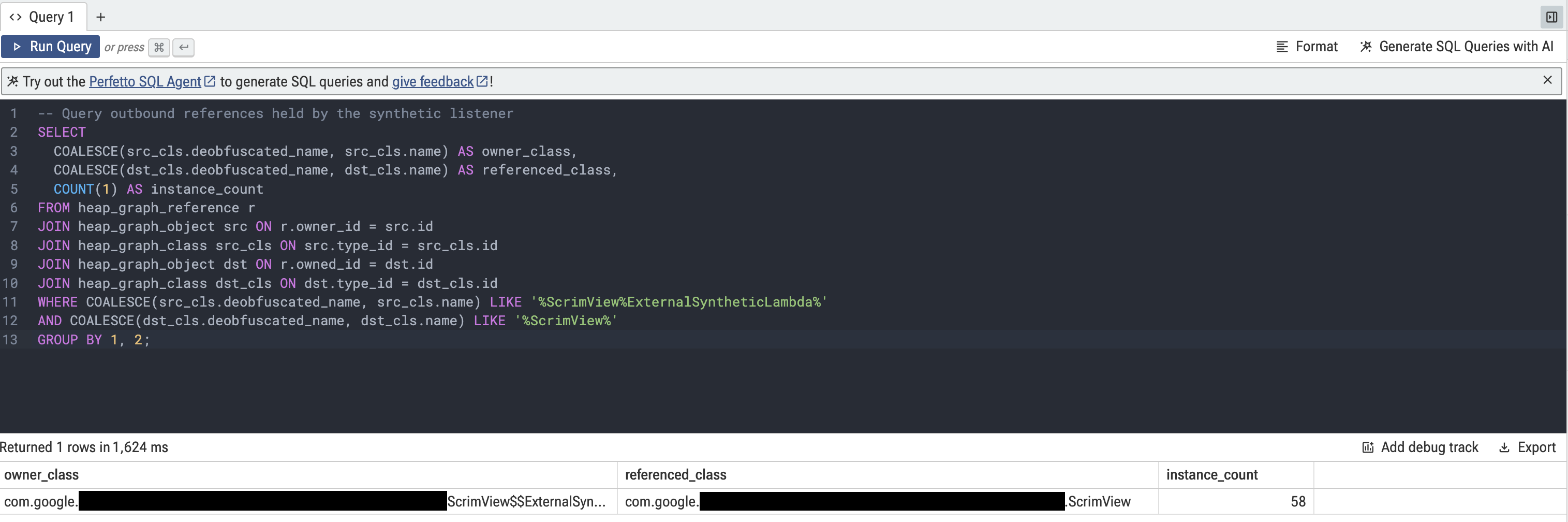 Figure 3: Running a custom query on heap_graph_reference in the Perfetto SQL editor verifies that all 58 synthetic lambda instances hold references back to ScrimView.
Step 4: The Immediate Fix
The fix was straightforward: unconditionally unregister the listener during window detachment, without relying on attach-state checks:
// ✅ FIX: 100% unconditional unregistration on window detachment
override fun onDetachedFromWindow() {
   super.onDetachedFromWindow()
   viewTreeObserver.removeOnPreDrawListener(recomputeScrimListener)
   isRecomputeScrimListenerAttached = false
}
Never route lifecycle teardown through dynamic business-state checks (like overrideOpacity == null). While property setters can manage listener attachment dynamically while the view is attached, cleanup in onDetachedFromWindow() must be unconditional, ensuring the listener is always removed when the view leaves the window.
Beyond ScrimView: 3 Other Silent Traps
While ScrimView was an attach-state lifecycle trap, our investigation across other applications revealed three more recurring patterns.
Trap 1: The Floating Observer Ghost
A common anti-pattern in Android development is attempting to clean up listeners during Fragment view destruction:
// ⚠️ Flawed unregistration in Fragment onDestroyView()
override fun onDestroyView() {
    super.onDestroyView()
    // 🚨 Silent Failure: Operates on a detached floating observer!
    binding?.root?.viewTreeObserver?.removeOnGlobalLayoutListener(myListener)
}
The Pathology: The mFloatingTreeObserver Trap
By the time a Fragment executes onDestroyView(), its view hierarchy has already been completely detached from the window (mAttachInfo == null).
Under the hood in AOSP, when mAttachInfo is null, calling view.viewTreeObserver does not return the active Window observer. Instead, it instantiates a brand-new, empty floating observer (mFloatingTreeObserver).
The removeOnGlobalLayoutListener(...) call executes against this ghost observer and silently does nothing. Meanwhile, the live Window-scoped ViewTreeObserver still holds onto your listener, permanently leaking the Fragment and its view hierarchy.
The Critical Timing Contrast:
- Inside
onDetachedFromWindow():mAttachInfois still non-null, soviewTreeObserversuccessfully resolves to the active Window observer.- Inside Fragment
onDestroyView(): Detachment is already complete (mAttachInfo == null), silently redirecting allviewTreeObservercalls to an unattachedmFloatingTreeObserver.
Trap 2: The Kotlin SAM & Method Reference Trap
In modern Kotlin, developers frequently pass method references or inline lambdas, assuming they act as stable function pointers:
// 1. Registration (Kotlin creates SAM instance #1):
view.viewTreeObserver.addOnGlobalLayoutListener(this::onGlobalLayout)

// 2. Teardown (🚨 Silent Failure: Kotlin creates a BRAND-NEW SAM instance #2!):
view.viewTreeObserver.removeOnGlobalLayoutListener(this::onGlobalLayout)
The Pathology: Reference Equality (===) in CopyOnWriteArray
Under the hood in AOSP, ViewTreeObserver stores listeners in an internal array (CopyOnWriteArray<T>) and removes them using strict reference equality (===).
In Kotlin, passing a method reference (this::onGlobalLayout) triggers SAM (Single Abstract Method) conversion. Every time you evaluate this::onGlobalLayout, the Kotlin compiler instantiates a new wrapper object:
Because of that, the removal call silently fails to find a match and does nothing. The initial listener remains registered on the window hierarchy indefinitely.
Rule of Thumb: If you register a
ViewTreeObserverlistener, store it in an explicit property (e.g.private val layoutListener = ViewTreeObserver.OnGlobalLayoutListener { ... }) and pass that exact same instance to bothaddOn...ListenerandremoveOn...Listener.
Trap 3: The One-Way Unregistration Ticket
Another fragile pattern is attempting to self-unregister directly inside a one-shot callback:
// ⚠️ Fragile self-unregistration attempt in Kotlin
val drawListener = object : ViewTreeObserver.OnDrawListener {
    override fun onDraw() {
        // 🚨 CRASH: Throws IllegalStateException in AOSP!
        view.viewTreeObserver.removeOnDrawListener(this)
        performAction()
    }
}
view.viewTreeObserver.addOnDrawListener(drawListener)
The Pathology: mInDispatchOnDraw and Detachment Races
This pattern introduces two severe failure modes:
- Immediate Crash via
IllegalStateException:
UnlikeremoveOnPreDrawListener(which is safely permitted during pre-draw dispatch),removeOnDrawListeneris explicitly prohibited while drawing is in flight. Under the hood,ViewTreeObserversetsmInDispatchOnDraw = trueduring traversal:
// Inside android.view.ViewTreeObserver (AOSP):
public void removeOnDrawListener(OnDrawListener victim) {
        checkIsAlive();
        if (mOnDrawListeners == null) {
            return;
        }
        if (mInDispatchOnDraw) {
            IllegalStateException ex = new IllegalStateException(
                    "Cannot call removeOnDrawListener inside of onDraw");
            if (sIllegalOnDrawModificationIsFatal) {
                throw ex;
            } else {
                Log.e("ViewTreeObserver", ex.getMessage(), ex);
            }
        }
        mOnDrawListeners.remove(victim);
}- The Detachment Trap (Stranded Observers):
Even when usingOnPreDrawListener(where self-removal is permitted without throwing), self-unregistration assumes the callback is guaranteed to run. If the view is removed from the hierarchy, markedView.GONE, or detached before the next traversal pass occurs,onDraw()/onPreDraw()will never execute. The listener remains stranded on the window'sViewTreeObserverindefinitely.
The Fix: Safe Engineering Patterns
Pattern 1: Prefer View-Scoped Layout Listeners
If observing layout changes on a single View, avoid ViewTreeObserver entirely. Use View.OnLayoutChangeListener:
// ✅ Scoped to the View instance; does not touch Window ViewTreeObserver
val layoutListener = View.OnLayoutChangeListener { v, left, top, right, bottom, oldL, oldT, oldR, oldB ->
    updateToolbarWidth(right - left)
}
toolbar.addOnLayoutChangeListener(layoutListener)

// Teardown:
toolbar.removeOnLayoutChangeListener(layoutListener)
Unlike ViewTreeObserver (which attaches callbacks to the window-level ViewRootImpl), View.OnLayoutChangeListener callbacks are stored directly inside the view itself at View.mListenerInfo.mOnLayoutChangeListeners.
Because the callback never escapes to the window root, it shares the exact same lifecycle as the host view. If you forget to unregister it, the listener is still naturally garbage-collected alongside the View without holding the entire window tree hostage.
Pattern 2: When Window-Wide Observation is Truly Necessary
While single views should use View.OnLayoutChangeListener, there are valid scenarios where you genuinely need a Window-scoped ViewTreeObserver, such as detecting soft-keyboard (IME) insets, observing scroll offsets across arbitrary sibling views, or coordinating multi-view screen layouts.
When registering a ViewTreeObserver listener (especially when wrapping it with tracing or analytical proxies), use a lifecycle-bound wrapper that manages attachment and guarantees safe unregistration:
/**
 * Safely manages a Window-scoped ViewTreeObserver listener by binding it
 * to a host View's window attachment lifecycle.
 */
class SafeGlobalLayoutObserver(
    private val hostView: View,
    private val callback: () -> Unit
) : View.OnAttachStateChangeListener {

    // 1. Hold an explicit reference so removal reference equality (===) succeeds
    private var activeWrapper: ViewTreeObserver.OnGlobalLayoutListener? = null

    fun attach() {
        hostView.addOnAttachStateChangeListener(this)
        if (hostView.isAttachedToWindow) {
            registerOnWindow()
        }
    }

    fun detach() {
        hostView.removeOnAttachStateChangeListener(this)
        unregisterFromWindow()
    }

    override fun onViewAttachedToWindow(v: View) {
        registerOnWindow()
    }

    override fun onViewDetachedFromWindow(v: View) {
        unregisterFromWindow()
    }

    private fun registerOnWindow() {
        if (activeWrapper != null) return
        val wrapper = ViewTreeObserver.OnGlobalLayoutListener {
            Trace.beginSection("global_layout_pass")
            try {
                callback()
            } finally {
                Trace.endSection()
            }
        }
        hostView.viewTreeObserver.addOnGlobalLayoutListener(wrapper)
        activeWrapper = wrapper
    }

    private fun unregisterFromWindow() {
        val wrapper = activeWrapper ?: return
        val vto = hostView.viewTreeObserver
        // 2. Guard against window teardown where ViewTreeObserver is no longer alive
        if (vto.isAlive) {
            vto.removeOnGlobalLayoutListener(wrapper)
        }
        activeWrapper = null
    }
}
Pattern 3: AndroidX `doOnPreDraw` and `doOnLayout` Utilities
For one-shot measurement, layout, or animation callbacks, avoid manually registering ViewTreeObserver listeners. Instead, use the Kotlin extension functions provided by androidx.core:core-ktx:
import androidx.core.view.doOnPreDraw
import androidx.core.view.doOnLayout

// ✅ Safe, one-shot pre-draw callback
view.doOnPreDraw { v ->
    updateUI(v.width)
}

// ✅ Safe, one-shot layout callback
view.doOnLayout { v ->
    alignFloatingButton(v.top)
}
Why it's immune to detachment races
Under the hood, doOnPreDraw relies on AndroidX's OneShotPreDrawListener, which simultaneously implements both ViewTreeObserver.OnPreDrawListener and View.OnAttachStateChangeListener.
- If the draw pass happens: It removes the listener from
ViewTreeObserverand executes your lambda. - If the view is detached before drawing:
onViewDetachedFromWindow()triggers automatically, unregistering the listener before it can ever be stranded on the window hierarchy.
Similarly, doOnLayout uses a self-removing View.OnLayoutChangeListener, which is safely scoped to the View instance.
Over to You
Memory leaks like this often remain completely invisible until telemetry flags a spike in production crashes or OutOfMemory errors.
- Have you encountered unexpected memory retention from window-scoped listeners in your own apps?
- How often do you capture and analyze Java heap dumps in Perfetto?
- What is the sneakiest or largest memory leak you have ever tracked down? Let us know your thoughts, questions, and experiences in the comments below!